August 14, 2026 · 10 min read
Subperiosteal Implants: A Modern Solution for Patients With Severe Bone Loss
For patients with severe jawbone loss, conventional dental implants may not be straightforward. Modern custom subperiosteal implants are an advanced option worth understanding.
For many years, patients with severe jawbone loss were told that dental implants were difficult or sometimes impossible without extensive bone grafting. Today, advances in digital dentistry, 3D imaging, and custom manufacturing have brought renewed attention to an alternative approach: custom-made subperiosteal dental implants.
Modern subperiosteal implants can provide a valuable treatment option for carefully selected patients with severe maxillary or mandibular bone atrophy, particularly when conventional dental implants or extensive bone augmentation are not ideal.
What Are Subperiosteal Dental Implants?
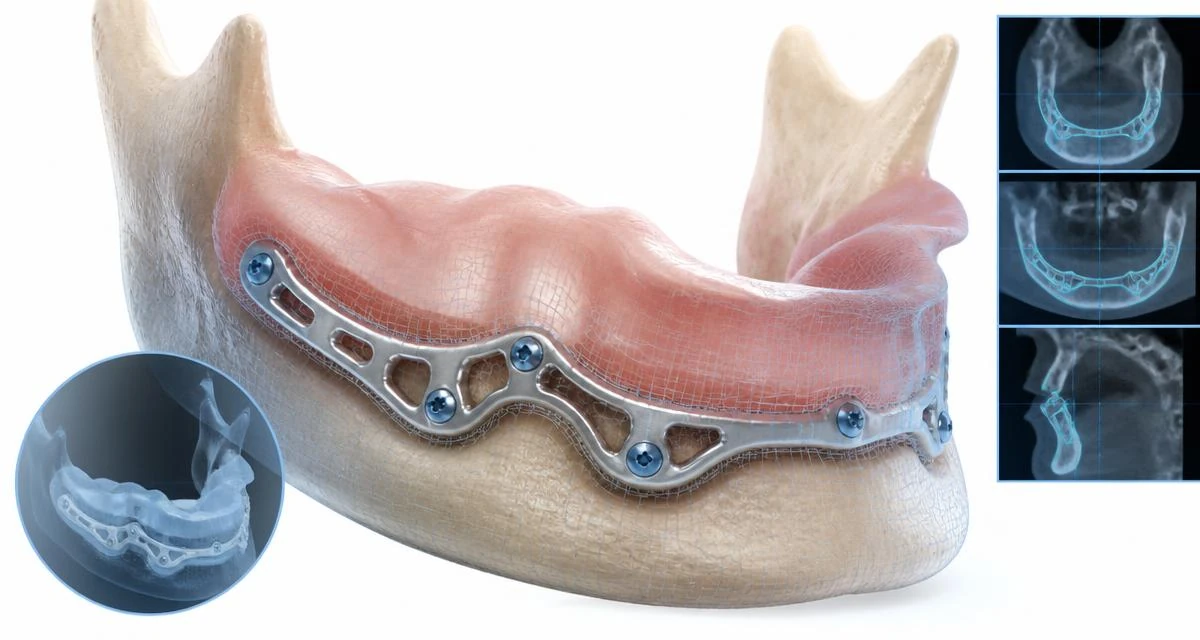
Unlike conventional dental implants, which are placed inside the jawbone, a subperiosteal implant is designed to sit on the surface of the bone, underneath the gum tissue.
The implant framework is custom-designed to follow the patient's unique jaw anatomy and is stabilized using fixation screws in selected areas of available bone.
The prosthetic components then extend through the gum tissue and support a fixed dental prosthesis.
Why Are Modern Subperiosteal Implants Different?
Subperiosteal implants are not a completely new concept. Earlier versions were used decades ago, but limitations in imaging, manufacturing accuracy, surgical techniques, and materials contributed to variable outcomes.
The modern approach is significantly different.
Today, CBCT imaging and digital 3D planning allow the patient's jawbone to be reconstructed virtually. A custom implant framework can then be digitally designed to fit the patient's anatomy and manufactured using advanced technologies, commonly with titanium.
This combination of digital planning, patient-specific design, and modern manufacturing has renewed interest in subperiosteal implants for complex cases.
Who May Benefit From Subperiosteal Implants?
Subperiosteal implants may be considered for patients with severe bone loss who cannot easily receive conventional implants.
Potential candidates may include patients who:
- Have severe maxillary or mandibular bone atrophy
- Have experienced extensive bone resorption after years without teeth
- Have insufficient bone for conventional implant placement
- Have previously undergone unsuccessful implant or grafting procedures
- Want to avoid extensive bone augmentation when an alternative is appropriate
- Require a fixed dental solution in a complex anatomical situation
Careful patient selection is essential, and not every patient with bone loss is a candidate.
Can Subperiosteal Implants Avoid Bone Grafting?
This is one of their most interesting potential advantages.
Traditional implant treatment requires sufficient bone volume to surround and support the implant. In patients with severe bone loss, this may require procedures such as bone grafting, sinus augmentation, or other advanced reconstructive techniques.
Because a subperiosteal implant is positioned over the remaining bone rather than relying on a conventional implant fixture being completely surrounded by bone, it may allow selected patients to receive treatment without major bone grafting procedures.
However, the appropriate approach should always be determined individually after evaluating the patient's anatomy, medical history, and alternative treatment options.
How Are Subperiosteal Implants Made?
Modern treatment begins with detailed 3D CBCT imaging.
The patient's anatomy is digitally reconstructed, allowing the clinician and engineering team to evaluate the remaining bone and surrounding anatomical structures.
A patient-specific implant framework is then designed to adapt precisely to the jaw.
The general workflow may include:
- 3D CBCT examination
- Digital reconstruction of the jaw
- Virtual treatment planning
- Custom design of the subperiosteal implant
- Manufacturing of the patient-specific titanium framework
- Surgical placement and fixation
- Connection of the prosthetic components
- Delivery of the planned fixed dental prosthesis
This digital workflow is one of the major differences between modern subperiosteal implants and the historical techniques used decades ago.
Can Patients Receive Fixed Teeth Immediately?
Depending on the implant design, fixation, prosthetic plan, and individual clinical situation, immediate or early prosthetic loading may be considered in selected cases.
This can be particularly attractive for patients with severe bone loss who want to restore function without undergoing multiple major bone-grafting procedures followed by prolonged healing periods.
However, immediate loading is not automatically appropriate for every patient. The decision depends on mechanical stability, implant design, bone quality, occlusion, and several other clinical factors.
Subperiosteal Implants vs Conventional Dental Implants
Conventional endosseous dental implants remain the most established and extensively researched implant treatment and should be considered whenever the patient's anatomy and clinical situation allow.
Subperiosteal implants should therefore not be viewed as a replacement for conventional dental implants.
Instead, they represent an additional treatment option for selected complex cases, particularly when severe bone loss makes conventional implant placement challenging.
Other advanced alternatives, including bone augmentation and zygomatic implants in severely atrophic maxillae, may also be considered depending on the case.
What Are the Advantages of Modern Subperiosteal Implants?
For appropriately selected patients, potential advantages include:
- Treatment of extremely reduced bone volume
- Potential avoidance of extensive bone grafting
- Patient-specific implant design
- Digital planning based on the patient's anatomy
- Possibility of fixed dental rehabilitation
- Potential reduction in the number of surgical stages in selected cases
The most important advantage is that patients previously considered extremely difficult implant candidates may have another potential pathway toward fixed teeth.
Are There Risks?
Yes. Subperiosteal implants are an advanced surgical treatment and are not without complications.
Potential complications can include infection, soft-tissue problems, implant exposure, mechanical complications, fixation problems, and implant failure.
Patients should therefore receive a careful assessment and understand both the potential advantages and limitations before proceeding with treatment.
A New Option for Severe Bone Loss
Severe bone loss does not necessarily mean that fixed implant-supported teeth are impossible.
Advances in CBCT imaging, digital treatment planning, CAD/CAM technology, and patient-specific titanium manufacturing have transformed the way complex implant cases can be approached.
Modern subperiosteal implants represent an exciting option for carefully selected patients with severe jawbone atrophy, particularly when conventional implants or extensive bone grafting may not be suitable.
The key is not simply choosing the newest technology, but selecting the right treatment for the right patient.
Frequently Asked Questions
Are subperiosteal implants new?
The concept has existed for decades. What has changed is the ability to use modern 3D imaging, digital planning, and patient-specific manufacturing to design significantly more precise implant frameworks.
Do subperiosteal implants require bone grafting?
One of their potential benefits is avoiding major bone grafting in selected patients. However, treatment requirements vary according to the individual case.
Are subperiosteal implants suitable for severe bone loss?
They may be considered specifically in certain patients with advanced jawbone atrophy where conventional implant placement is difficult.
Are subperiosteal implants better than conventional implants?
Not necessarily. Conventional dental implants remain the preferred and more extensively documented treatment whenever appropriate. Subperiosteal implants are primarily an alternative for selected complex cases.
Can I have fixed teeth with severe bone loss?
Potentially, yes. Depending on your anatomy, options may include conventional implants with bone augmentation, advanced implant techniques, zygomatic implants, or patient-specific subperiosteal implants.
A detailed clinical examination and 3D CBCT assessment are necessary to determine which approach is most appropriate.
Subperiosteal Implants in Riyadh
For patients with severe bone loss in the upper or lower jaw, modern implant dentistry may provide options even when conventional dental implant treatment is difficult.
A comprehensive evaluation, including clinical examination and 3D imaging, is essential to assess the remaining bone and determine whether conventional implants, bone augmentation, or a custom subperiosteal implant may be suitable.
Where conventional implants remain possible, treatment usually follows the standard pathway described in our guide to full-arch implant treatment.