September 2, 2026 · 11 min read
Same-Day Fixed Teeth After Dental Implants: How It Works and What to Expect
Leaving the clinic with fixed teeth on the day of implant surgery is possible — but what does it really involve? Here is how immediate loading works and what patients can expect.
One of the first questions patients ask before implant treatment is rarely about the implants themselves. It is simpler than that: "Will I be without teeth?" The idea of weeks spent hiding a smile, avoiding meetings, or wearing a removable temporary is often more distressing than the surgery.
Modern implant dentistry has an answer for many of these situations. In appropriately selected cases, implants can be placed and a fixed provisional set of teeth attached to them on the same day — an approach usually described as immediate loading, or informally as "teeth in a day". It is one part of the wider treatment pathway described in our guide to fixed full-arch implant treatment in Riyadh.
What follows is an explanation of what same-day fixed teeth genuinely involve, and — just as importantly — when they are not the right choice.
What does "same-day fixed teeth" actually mean?
The phrase is used loosely in advertising, so it helps to separate four different things.
Implant placement
The surgical stage, where the implants are positioned in the jawbone according to a treatment plan.
Immediate loading
A protocol in which a restoration is connected to the implants at, or very shortly after, surgery instead of waiting for a separate healing period before anything is attached.
Fixed provisional restoration
The first set of teeth. It is screwed onto the implants, so the patient cannot remove it, but it is designed as a working stage rather than the end result.
Definitive restoration
The final prosthesis, made after the provisional phase has confirmed function, aesthetics and hygiene access, and delivered according to the individual treatment plan.
So "same day" almost always refers to the fixed provisional teeth. It does not mean the entire treatment is finished in a single appointment, and any clinic that presents it that way is simplifying something that deserves an honest explanation.
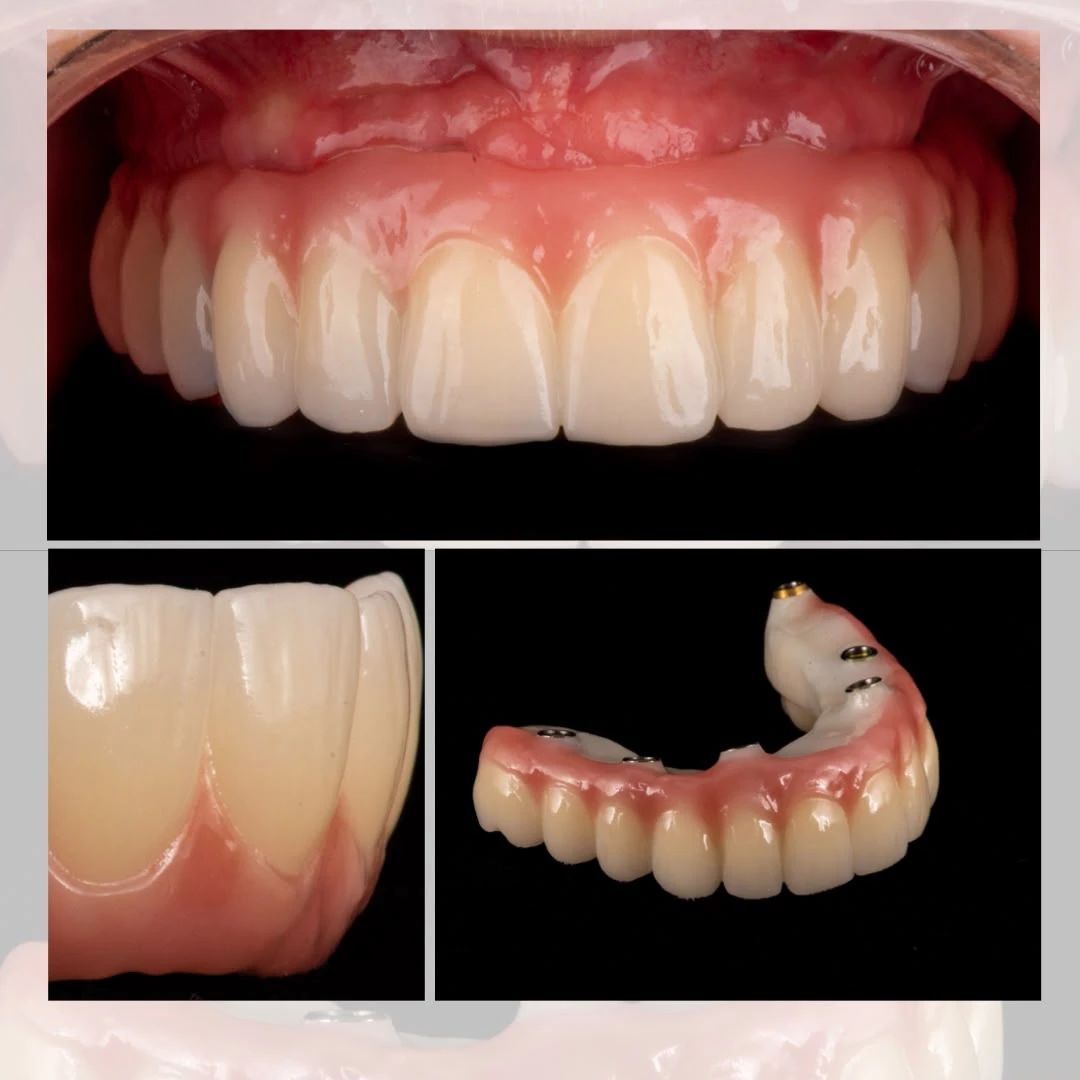
What is immediate loading, in plain terms?
An implant integrates with bone over time. Traditionally, clinicians waited for that process before attaching teeth, to protect the implant from movement during early healing.
Immediate loading takes a different route. When the implants are stable enough at the moment of placement, and when they are distributed in a way that allows forces to be shared across them, a rigid provisional bridge can splint the implants together and hold them still while healing continues. The bridge is not simply decoration — it becomes part of the mechanical protection.
That is why immediate loading is judged case by case. It depends on what is found in the mouth, not on what was promised in an advertisement.
Can I get fixed teeth on the same day as implant surgery?
Yes — in appropriately selected cases. When implant stability, bone conditions, implant number and distribution, bite and prosthetic design are all suitable, a fixed provisional restoration may be connected to the implants on the day of surgery.
But immediate loading is a clinical decision, not a guarantee. Part of that decision can only be made during surgery itself, once the implants are actually in place. A responsible plan therefore includes what happens if conditions are not favourable on the day.
What makes same-day fixed teeth possible?
At a broad level, same-day fixed teeth become possible when five things come together:
- Sufficient implant stability at the moment of placement.
- Bone that allows implants to be placed where the teeth need them.
- A spread of implants across the arch so forces can be shared.
- A prosthetic design that splints the implants together and controls bite forces.
- A digital plan prepared in advance, so surgery and the provisional restoration fit together on the day.
These explain how immediate loading becomes possible — not whether it is right for one particular person. Readers who want the clinical qualification factors in detail will find them in our dedicated article on who qualifies for immediate-load implants.
Why digital planning matters
This is where same-day treatment succeeds or quietly fails. Implants are not the goal — teeth are. The implants exist to support a prosthesis, so the prosthesis has to be designed first and the implant positions coordinated with it. That is what a prosthetically driven workflow means.
In practice the sequence runs in this order:
- Define the desired final teeth — position, length, midline, lip support and smile line.
- Digital smile and prosthetic design based on that goal.
- Three-dimensional imaging (CBCT) to assess bone volume, density and anatomy.
- Digital intraoral information, added when appropriate, to align the mouth with the scan data.
- Virtual implant planning that merges the prosthetic design with the anatomy.
- Prosthetically driven implant positioning, so implants sit where the teeth need them.
- Planned surgical and prosthetic execution, with the provisional prepared around the plan.
Placing implants where bone happens to be plentiful, then asking a technician to disguise the result, is the older way of working. It tends to produce bulky teeth, awkward screw access, or restorations that are difficult to clean. Planning the teeth first is the difference between a same-day result that looks improvised and one that was designed.
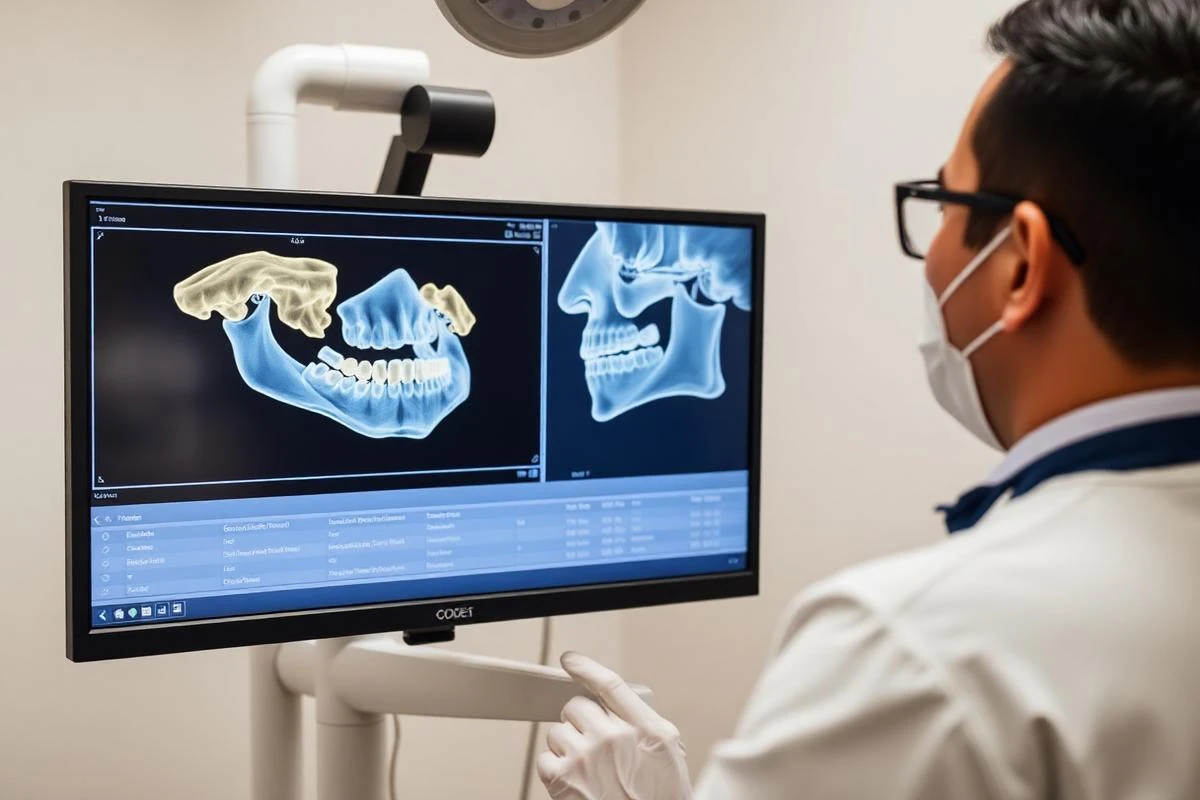
What happens on the day of treatment?
The day generally follows the plan prepared in advance:
- Planned removal of teeth that cannot be maintained, when this forms part of the treatment.
- Implant placement according to the digital plan.
- Verification of clinical conditions — stability and distribution — to confirm whether immediate loading is appropriate.
- The prosthetic workflow: recording implant positions and adapting the provisional design.
- Delivery of the fixed provisional restoration when conditions permit.
The third step is the honest one. If conditions on the day do not support immediate loading, the correct decision is to protect the result and follow an alternative pathway, such as a healing period before the fixed teeth are attached. A same-day promise made before this assessment is a marketing statement, not a clinical one.
Why is the first set of teeth provisional?
It is tempting to read "provisional" as "cheap temporary teeth to keep you going". In a well-run full-arch case it is closer to the opposite: the provisional is a diagnostic instrument that the patient wears and tests in real life.
During this phase the treatment team can evaluate:
- The smile — how the teeth appear at rest, when speaking and when smiling.
- Tooth length and position, and whether the midline and proportions sit correctly.
- Speech, which quickly reveals thickness or palatal contour problems.
- Lip support, and whether the prosthesis is too full or too flat.
- The bite, and how forces distribute during normal function.
- Function in everyday eating rather than in a dental chair.
- Hygiene access — whether the patient can genuinely clean around the implants.
- The patient's own feedback after living with the teeth.
Soft tissue also matures and reshapes around the provisional during this period. Everything learned here can be carried into the design of the definitive prosthesis, which is a far safer sequence than making the final teeth first and hoping.
When might same-day fixed teeth not be appropriate?
Immediate loading may not be advisable when adequate implant stability cannot be achieved, or when the biomechanical and prosthetic situation does not allow forces to be handled safely during early healing. Certain anatomical, healing-related or occlusal situations can also make a staged approach more predictable.
This is not an exhaustive list, and it is not a verdict that can be issued remotely. The principle is straightforward: predictability and long-term safety take priority over the appeal of finishing quickly. A delayed protocol that protects the implants is a better outcome than a same-day result that was not clinically justified.
Are same-day teeth the same as All-on-4?
No, although the terms are often used interchangeably in advertising.
Immediate loading describes the timing — when the restoration is attached relative to surgery. All-on-4 describes a particular treatment concept and implant configuration. A patient can receive immediate loading with a plan that is not All-on-4, and a plan can use four implants without being loaded immediately.
Implant number, position, angulation and distribution should be decided from the individual anatomy and prosthetic requirements. Four implants suit some arches well; others benefit from a different arrangement. Presenting one configuration as universally preferable is a simplification.
What happens after the same-day provisional?
The provisional phase is followed by review appointments, during which healing, soft tissue, bite and hygiene are monitored, and adjustments are made where needed. Once the clinical situation is judged ready, work on the definitive prosthesis begins, informed by everything the provisional demonstrated.
There is no single universal timeline. How long this phase lasts depends on the individual case — healing behaviour, the extent of treatment, and what the provisional reveals about function and aesthetics.
What material is used for the final teeth?
The definitive prosthesis can be made from several materials, and the choice is made case by case according to bite forces, available space, aesthetic requirements, opposing teeth and maintenance considerations.
Zirconia is one option frequently used for fixed full-arch restorations, but it is not universally superior; other material combinations are appropriate in particular situations. This is a decision for the treatment plan rather than a preference applied to everyone.
Is immediate loading painful?
Treatment is carried out under appropriate anaesthesia, so the procedure itself is managed for comfort. It would be wrong, however, to describe any surgical treatment as painless.
Postoperative discomfort, swelling and tenderness vary between patients and according to the extent of treatment, and are managed with instructions and medication as advised. Sedation or general anaesthesia is considered for some cases; you can read more in our article on general anaesthesia and dental implant safety.
And what about eligibility?
Whether immediate loading is right for you is an individual clinical judgement, based on an examination and three-dimensional imaging rather than an advertisement or a photograph. Because that question deserves its own detailed answer, it is covered separately in our article on who qualifies for immediate-load implants.
Frequently asked questions
Can dental implants really have fixed teeth on the same day?
In suitable cases, yes. When implant stability and the prosthetic situation allow it, a fixed provisional bridge can be attached on the day of surgery. It is decided case by case, and confirmed during the procedure.
Are same-day teeth permanent?
No. The teeth delivered on the day are a fixed provisional restoration. They are a working stage used to evaluate aesthetics, speech, bite and hygiene before the definitive prosthesis is made.
What is immediate loading?
It is a protocol where a restoration is connected to the implants at or shortly after placement, rather than waiting for a separate healing period before anything is attached.
Can damaged teeth be removed and implants placed on the same day?
In many planned cases, removal of non-maintainable teeth, implant placement and delivery of a fixed provisional are combined. Suitability depends on the clinical findings and the site conditions after extraction.
Is immediate loading the same as All-on-4?
No. Immediate loading refers to the timing of the restoration; All-on-4 refers to a specific implant configuration. They can occur together, but they are not the same thing.
Can both the upper and lower arches be treated?
Both arches can be considered, either together or in stages. Bone conditions and bite forces often differ between the jaws, so each arch is assessed on its own terms.
What happens if immediate loading is not appropriate on the day of treatment?
A well-made plan includes an alternative: the implants are left to heal, a suitable interim solution is used, and the fixed teeth are attached later. The clinical factors behind that decision are covered in our article on who qualifies for immediate-load implants.
About the author
Dr. Adnan Bazarbashi is a Saudi consultant in prosthodontics, cosmetic dentistry and dental implants, trained at the University of Southern California. He works at King Saud University and in private practice at Confident Clinic in Riyadh, with a focus on full-mouth rehabilitation and digitally planned implant treatment.
Considering fixed teeth with dental implants?
A clinical examination and three-dimensional assessment can help determine whether immediate loading is appropriate in your case, and which implant and prosthetic approach fits your anatomy and goals.
You can review the complete treatment pathway on our Riyadh full-arch implant page, or arrange a consultation to have your own situation assessed.